Market Commentary
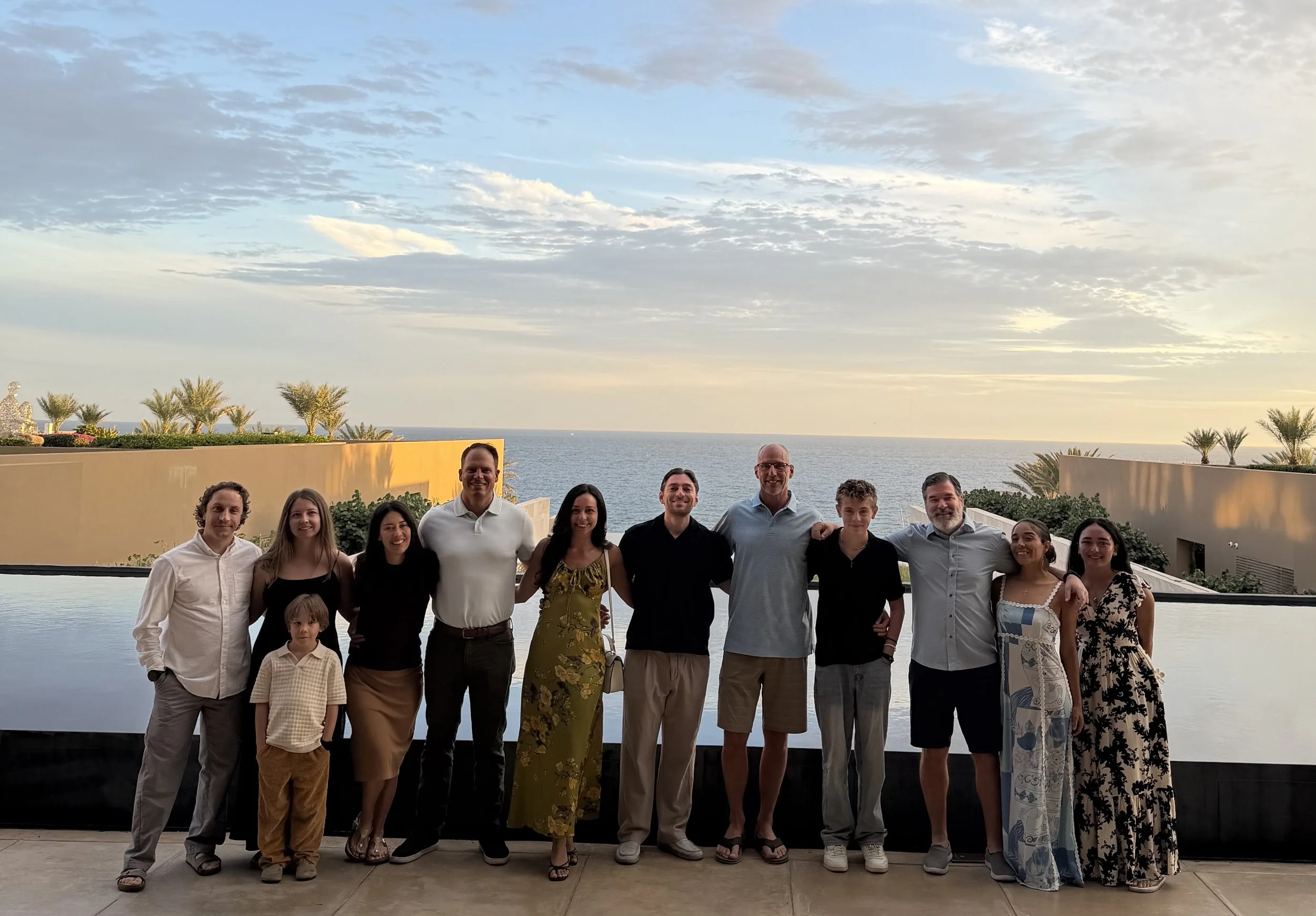
I want to start this month with a sincere "thank you!" to all our wonderful clients. We had a great 2025, and because of the trust and confidence you all continue to place in us, we had the privilege of gathering as a team in Cabo San Lucas, Mexico, for our annual team trip.
Since we live all over the country, we don't get to spend much time together in person, though we communicate constantly via Zoom and other electronic means. It is always valuable to gather in the same geographic area and break bread as a team.
Here are a few pictures from the trip.






Gold and silver had a wild ride in January. On the 28th, gold was up 25% for the month and the year 2026, while silver was up 62%! Two days later, when the month ended, gold had fallen nearly 10%, and silver had dropped 27%! Talk about volatility!
Even after the drop, gold managed to finish the month up 13.3%, leading all the indexes we have been tracking in this commentary, and silver still finished up nearly 19%.
Why? Who knows? There is no shortage of theories, but the simplest answer is "because they had gone up so much." More on this later.
In a recent commentary, I addressed whether I thought gold was in a bubble. Short answer: I didn't. Today, I still don't.
The fundamental case for a much higher gold price remains sound. What happened in the interim is that gold (and silver) had turned into "momentum trades." And momentum traders are in for one reason: it (whatever it is) is going up. When that stops, all those short-term traders head for the exits at once, leaving more sellers than buyers, which always results in aggressive price drops. Simple as that.
My base-case expectation from here is for gold to trade sideways within a range, with increased volatility for a while. The metal is basically flat through the first half of February.
It looks like we may be seeing the beginning of a rotation out of the mega-cap stocks and into the "forgotten 490" to start the year. Whether this will continue, I don't know. The Top 10 largest stocks by market capitalization were down 0.9% in January, while the Equal Weight S&P 500 was up 3.3%, beating the benchmark S&P 500, which was up only 1.4%.
One month doesn't make it a trend. Over the past couple of years, there have been other months where the Equal Weight index beat the benchmark index, but that didn't persist.
The biggest winner, though, was small caps, which were up about 5% to start the year. Small caps have actually outperformed over the past six months or so, which is objectively more of a trend. We added a small-cap ETF to our model portfolios back in September, and we've been increasing that exposure as cash becomes available.
The S&P 500 is down so far in February and has given up its January gains. As you can see in the chart above, the index has been trading mostly sideways since the end of October and is now trading below the 50-day moving average (DMA). The 50DMA is moving sideways with the index, but the 200DMA is still trending higher.
Remember, the 200DMA is the long-term trend, and the 50DMA is the intermediate-term trend. So, for now, taking both into consideration, the bias is still upward. Not much to see here.
Don't worry, though, the S&P 500 is still extremely overvalued on basically any fundamental metric you can think of. I'll spare you the charts this month.
The big story of the month has been the absolute pummeling of software stocks, which has only accelerated in February with the release of Anthropic's new AI tool, Claude Cowork, but the divergence started back in October.
The chart above shows the NASDAQ Composite index vs. the software ETF (IGV) going back to 2001 when IGV first began trading. It doesn't take a CFA Charterholder to see that these two have moved very similarly for nearly 25 years - until recently. The recent divergence is stark. It should get any investor's attention.
The divergence has led us to stop out of, and sell, some of the greatest businesses on earth, including Adobe (ADBE) and Automatic Data Processing (ADP), to name a couple.
We are either at the beginning of a paradigm shift in which software becomes totally obsolete, or we are being offered the buying opportunity of a lifetime. Of course, it could also be anywhere in between. I will be the first to admit that I have no idea how it will play out. That said, it is very difficult for me to see a world without software. But I am sure people felt similarly about horses when the first automobiles were invented, with no interstate road system for them to drive on.
I suspect — though how can I really know? — that the baby is being thrown out with the bathwater here. I am trying to figure out a) if that is true and b) if so, which companies are the babies and which are the bathwater.
I have some ideas I am researching, but I won't pretend to know where they will lead.
It is difficult for me to imagine a world where every individual uses Claude Cowork, or some other AI tool, to build their own word processor, pdf reader, payroll system, stock charting tools, video conferencing, email platform, web browser, client relationship management system, etc... rather than paying a relatively low monthly or annual subscription fee to Microsoft, Adobe, Google, Salesforce, ADP, or Tradingview, who already have world-class software-as-a-service (SaaS) businesses.
On the other hand, it is very easy for me to believe that some niche, single-use software just goes away.
It is also easy for me to believe that some SaaS prices will fall to make "doing it yourself" less appealing.
Ironically, at least to me, the SaaS segment is the largest part of overall cloud computing revenue for the hyperscalers building data centers around the world, and likely accounts for the majority of “cloud workloads” by count, based on my initial research. If all those SaaS companies go away, who are we building these data centers for?
Arguably, on the other hand, each individual using AI to code their own software tools would require even more cloud computing capacity than if everyone just bought the same solution from a software company.
Think of it as if everyone wanted to run their own electricity from the power plant to their home instead of just using the wires that already come from the power plant into their neighborhood. That is at least partly why utility companies are highly regulated and effectively guaranteed a profit despite their high capital intensity. What if hyperscalers turn out to be highly regulated and capital-intensive from now on? With all the capital expenditures to build data centers and fill them with GPUs and TPUs, the depreciation is sure to come, whether on an accelerated or extended timeframe.
You see, when a company makes a big capital expenditure (say, a data center), the cash goes out immediately, but the expense hits profits slowly over time through depreciation.
In the year the money is spent (year 0), a company spends, say, $1 billion on a data center. That $1 billion does not show up as an expense on the income statement; it becomes an asset on the balance sheet.
Each year after the expense, the company records a depreciation expense (for example, $100 million per year for 10 years) on the income statement. That depreciation reduces accounting profit (Earnings per Share) each year.
So even though the cash was spent up front, the hit to reported profit is spread out over several years. Depreciation reduces net income.
So, "capex" itself doesn’t immediately reduce profit, but the depreciation that follows is an annual expense that drags down accounting profits over the life of the asset.
I don't think anyone knows how this will play out. Those who are certain of the SaaS-pocalypse and the certain death of all software businesses are probably wrong. Those who are certain this is the opportunity of a lifetime and all software stocks will come roaring back are probably wrong.
I think the best thing to do, as usual, is to admit that I don't know and focus on managing the risk of being wrong, like we always do.
So far, none of the best SaaS companies I follow have reported anything but consistent, sustained growth in revenue, accounting profits, and free cash flow, even if the growth rate may have slowed somewhat, as expected in mature businesses. All have also provided strong guidance for the upcoming quarters.
Since I am a financial analyst and not a visionary technologist, I plan to keep analyzing the financial reports as they come out and try to separate the babies from the bathwater. If/when the highest-quality, most capital-efficient businesses stop falling and start trending higher, I'll buy them with both hands, in an appropriate size, and with a predetermined exit strategy.
Other big news was the announcement of President Trump's nominee for the new Chairman of the Federal Reserve, Kevin Warsh. This announcement is the leading theory for what triggered the selloffs in gold and silver discussed earlier.
Warsh has been critical of the size of the Fed's balance sheet in the past. Reducing the balance sheet, all else equal, would raise interest rates and boost the dollar, both of which are bad for gold.
However, all else is rarely, if ever, equal.
Who knows what Warsh will actually advocate for, but Trump wouldn't have chosen him if he didn't think Warsh was a "low interest rate person."
Assuming Warsh is still hawkish on the balance sheet, interest rates would have to go even lower than they otherwise would be to offset any decrease in the Fed's balance sheet.
The market currently expects only two Fed rate cuts in 2026. My guess (not prediction) is that additional rate cuts will be priced in as the year unfolds.
Inflation and unemployment support that thesis, for now. Have a look. Inflation appears to be slowing toward the Fed's stated target of 2% while unemployment appears to be rising. Both of these support the case for rate cuts.
Have a look:
It may be frustrating that I seem to have more questions than answers in this commentary, but the truth is that's usually the case. And for what it is worth, when I am hiring someone, a general rule that I follow is to look for people who ask great questions rather than those who give great answers. I hope you feel the same.
Until next time, I will continue to ask questions and look for answers as to whether a rotation from mega-cap stocks to the "forgotten 490" will persist and whether the death of SaaS has been greatly exaggerated.
And as always, I thank God for each of you, and I thank each of you for reading this commentary. For those of you who observe it, may you have a wonderful, spirit-filled Lenten season that brings you closer to Jesus Christ, our Lord and Savior.
I hope you found this commentary both useful and enjoyable. Please tell me what you think - good, bad, or otherwise.
Would you recommend it to people you know? Why or why not? What about our portfolio management and financial planning services?
Click here and let me know!
Clients, I encourage you to click here to access your personalized performance portal and see how your portfolio performed compared to the market's last month.
Shane Fleury, CFA
Chief Investment Officer
Elevate Capital Advisors
Legal Information and Disclosures
This commentary expresses the views of the author as of the date indicated and such views are subject to change without notice. Elevate Capital Advisors, LLC (“Elevate”) has no duty or obligation to update the information contained herein. This information is being made available for educational purposes only. Certain information contained herein concerning economic trends and performance is based on or derived from information provided by independent third-party sources. Elevate believes that the sources from which such information has been obtained are reliable; however, it cannot guarantee the accuracy of such information and has not independently verified the accuracy or completeness of such information or the assumptions on which such information is based. This memorandum, including the information contained herein, may not be copied, reproduced, republished, or posted in whole or in part, in any form without the prior written consent of Elevate. Further, wherever there exists the potential for profit there is also the risk of loss.